


Contextualization in evangelism---'Should christian minister adapt rock and roll culture' ?

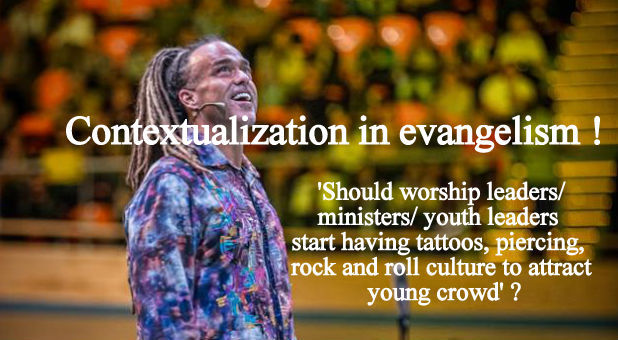
Certainly, there are many ways that missionaries/ministrers/ cross-cultural youth leaders can and should contextualize: food, living situations, language, cultural restrictions, clothing, etc. I was missionary and I had to contextualize in 'Just the way I talked with villagers' and 'the way I wear clothing', of course that was in Christian liberty to do certain things but 'to restrict my liberty saved a lot of unnecessary distance and in some cases more than just a distance between me and people'. One argument we often get is, Well anybody could then adopt 'Rock and roll personality, rap music, Tatoos , cigars , even moderate drinking , in order to reduce unnecessary distance between culture and evangelism'. This is where I call 'Over-contextualisation' takes place when you're crossing the wisdom-line to know what affects your message and christian life differences with the world'. 1] Doing what is right in the eyes of men :-
We all agree we cannot contextualize the gospel itself by changing the message but I would go far and say we can't over-contextualize our pattern of life, that might display worldliness in daily life'. Because there are some things that ultimately affect how the world perceives Christian virtues. Now some of the worldly adaptation we do can be 'sinless' but it can lead to 'sinfulness for those who observe us'. Paul says, We take pains to do what is right in the eyes of men(2 Cor 8:21). Think about it, many times we are just satisfied with saying 'God looks at heart I don't care how my outer appearance looks, it doesn't matter what other people think'. Then why would Paul say, we take 'pains' to do what is 'right' in the eyes of men? In context Paul specifically wanted to 'avoid any criticism of the way' (v20) with regard to 'money and offertory support'. Many of the best MSS. give: “For we provide for honest things,” as though he gave the general principle on which he was now acting in this particular instance. Mathew Henry says in this verse, "The apostle commends the brethren sent to collect their charity, that it might be known who they were, and how safely they might be trusted. It is the duty of all Christians to act prudently; to hinder, as far as we can, all unjust suspicions." The expression used here occurs in Romans 12:17. In that place, however, it refers to the manner in which we are to treat those who injure us; here it refers to the right way of using property; and it seems to have been a kind of maxim by which Paul regulated his life, a "vade mecum" that was applicable to everything. The sentiment is, that we are to see to it beforehand that all our conduct shall be that no unbeliever or other weak disciples would see us and say ' It is important to distinguish between 'Doctrinal courage and taking a stand for God's word and truth', and 'taking a stand for personal living preferences'. This principle is hard for many 'culturally saturated Christians' since they often want a culturally updated version of themselves. So they try to incorporate everything, which might come under 'Christian liberty'. For that matter, Tattoos and piercing, moderate drinking, smoking occasional cigars come under obvious Christian liberty, but Paul also said 'If my way of living becomes a stumbling block for others', I must restrict my liberty. This is where we need 'self-denial'. Mature people think how to deny rights for the glory of God, immature people always think how to gratify rights to satisfy self. This might apply to hair-style, certain language, make up style etc. You don't know what 'green signal with the culture' your appearance gives to someone, and we can't track down every person's thoughts in that case we can't do any entertainment in this life. But we can at least refrain from something which is inherently connected to evil culture. i.e. Occasionally going out with friends to the place which is known for 'drug addicts' is not sinful per se, but it is inherently connected to the drug community and their immorality. Many christians might doubt even your presence in such places.
2] Everything is permissible but, Is it beneficial?
In context the above words in 1 Co. 10:23 is the question of the eating of meat offered to idols, from which immediate subject the strong expression of personal feeling in 1Corinthians 8:13 followed the mind of the apostle. Everywhere the question is offending the weaker brother. Meat offered to idols actually offended those christians who were converted from idol-culture who regularly consumed meat in their temple sacrifices and then offered them in the Corinthian meat market. If Paul or Corinthian believers were taking liberty to eat that, new converts took notice of it and were struck in their conscience about 'Christian morals'. Certain things are permissible but not beneficial in the long run. This is the most important principle when it comes to 'how far should we go in contextualization'. Ask the simple question, 'Is my Christian liberty in any way shape or form inviting worldliness in my appearance'? If yes, why should we consider using our rights? Many people immediately claim when they invite rock and roll culture into the Church by saying, "I became all things to all men" (1 Cor. 9:22). I believe contextually the whole passage is talking about 'sacrificing' in order not to create offence or persecution from 'Jews' but to win 'Jews' (V20) Paul adapted 'Jewish vows' (Acts 16:3, 21:23-26) even though he knew he is not under Jewish ceremonial law. This would avoid the persecution from unnecessary infiltrators and would eventually allow Paul to use it as entry pass in their synagogues. Now adapting Jewish ceremony for an instance was not 'inherently sinful unless it was mixed with a message of salvation'. But the same application can't be applied today, because we are not Jews and we for the most part do not evangelize to Jewish Synagogues. Unless someone is a true Israelite today, if someone tried to copy Paul's strategy by adapting Hindu ceremonies and rituals that would be a disaster because pagan ceremonies are not the same as 'Old Testament ceremonial system prescribed by Moses', they are inherently attached to 'Idol worship'. Paul could never imagine this kind of application in modern church. Secondly Paul restricted his certain Jewish rights to win 'Gentiles' (v.21), Paul restricted and at times opposed those who tried to impose Jewishness to Gentiles (Gal 2:14), he was ready to live as if he was not Jew. He ate with Gentile, he stayed with gentile, he roamed with gentile and he identified with gentile to win them in this sense he became like them. This is certainly not talking about 'adapting Gentile trend' but 'living conditions where Paul fearlessly went into Gentile circles'. And for the weak (v.22), Paul stooped down to not offend, He was ready to restrict his right to eat meat (1 Co 8:13). We see for all three people group Paul was concerned about 'sacrificing' himself. For all three instances (Jews Gentiles Weak), Paul's maxim was 'Everything is permission but will it be beneficial for the people group? Got amazing piece of write up by GTY on adopting worldliness in the name of 1 Corinthians 9:22 (I became all things to all men), Sadly, the modern church has turned that principle on its head. Today believers confuse the concept of being all things to all men, using it as license to imitate the world and embody the characteristics of the subculture they want to reach. Even worse, whole churches apply it as a marketing strategy, attempting to fashion themselves according to the trends and interests of the world. The notion that the church must become like the world to win the world is the dogma of the day. Virtually every modern worldly attraction has a “Christian” counterpart. We have Christian motorcycle gangs, Christian bodybuilding teams, Christian tattoo club, Christian dance clubs, Christian amusement parks, and even Christian nudist colonies. Is this what Paul is saying in 1 Corinthians? No. It was about Self-Sacrifice, Not Compromise. What was Paul actually saying in those verses? He described not his adoption of worldly practices, but rather his willingness to sacrifice himself to win people to Christ. He would give up anything—even become “a slave to all”—if that would promote the spread of the unadulterated gospel. 3] There is difference between adapting culture and adapting 'Latest trends' :-
There are different cultures in the world, particular fashions developed within various people groups: lederhosen and dirndls in southern Germany and Austria; kilts in Scotland; saris in India; kolts in Scandinavia; and ghos and kiras in Bhutan. There are types of “clothing” designed to identify the wearer with a certain group. Law enforcement officers wear certain outfits—uniforms—to identify their role in society. Various church denominations have required vestments for their clergy. In Jesus’ day, the Pharisees wore long robes with tassels and phylacteries part of their religious dogma(see Matthew 23:5). But on the other hand, there is fashion and trends for fashion’s sake. Designers and the wearers of the designs may use clothing as artwork or to make statements or simply to draw attention to themselves. Such fashions are often faddish and come and go quickly. This is not related to culture in it's ethnicity or profession but 'Spirit of the Age'. If you are going into a cutting edge missionary condition in the middle of India and trying to adjust with a local language group , their way of living, their dressing and their family norms which is completely different than chasing every new trend coming out from Hollywood to reach out to the 'Youth'. If we are saying ,we need to adapt culture it is often the indigenous people and their cultural norm , imagine chinese coming to India rather than nodding their heads at everyone they might need to learn the way we normally shake hands and greet , we don't prefer wearing Chinese attire which is totally different in it's ethnicity. But missionaries coming here would have to adapt Indian style dressing. But that is completely different from adapting 'dreadlocks and tattoos' to achieve numbers in hipster communities around the city corners. This I call 'over-contextualization' with added 'masalas' of personal infatuation. Now, someone immediately says but 'having dreadlocks is not Sin but Christian liberty, don't be judgemental selwin'. Ohh there you go, you have missed the principle of 'Spiritual usefulness while protecting individual liberty'. Secondly, you might have a misunderstanding of 'what is Biblical judgement and should we judge or not? Don't be surprised if believers are called to judge. (1 Cor 5:12) Think about it, will 'dreadlock actually attract sinners to the Gospel , or actually make Christian look more trendy and fashion saturated'? There is a difference between wearing what is appropriate and wearing something extensively connected to a certain group of people in the world. What is dreadlock actually connected with? If you are not aware , The word “Rastafarianism” often calls to mind the stereotypical images of dreadlocks (long braids or natural locks of hair), ganja (marijuana), the streets of Kingston, Jamaica, and the reggae rhythms of Bob Marley. If at large something that signifies your connection with marijuana community (not necessarily every dreadlock person smokes marijuana), but I am speaking of 'stereotypical images' attached to that fashion undeniably speaks something to common people. Negative associations attached to anything should be carefully restricted even if it sounds convincing to keep it. As naive as it may sound eventually leads some others into that pragmatic dead end. Now imagine, if someone could learn from this that 'modesty principle in the Christian faith should be honoured' but if Christian themselves are into marijuana community practices why should new converts bother to look into how does he adopt any of the worldly patterns? Eventually the new convert is going to that road you never know becomes 'compromised-christian' taking liberty in many things which outright affects beyond hair-style. But says some, where in the Bible importance to dressing is addressed? Lord looks inward. Ohh you missed this, In describing the mode of dress appropriate for women in church, the apostle Paul exhorts them to dress “modestly” with “decency and propriety” then goes on to contrast immodest dress with the good deeds which are appropriate for those who profess to be true worshipers of God (1 Timothy 2:9–10). While the Bible only specifically addresses the need for women to dress modestly, the same teaching would apply to men in principle. Both men and women should bring glory to God in their manner of dress. Talking about rap music, first of all 'congregation can't join you if you are in a church setting doing worship', secondly rap songs are inherently connected with hip-hop gangculture. (Source: "Gangsta Rap – What Is Gangsta Rap". Rap.about.com. October 31, 2009. Retrieved April 23, 2010 ), Gangsta rap is a subgenre of hip hop that reflects the violent lifestyles of inner-city American black youths. Rap has a track record of being profane, violent, and sexual. Unfortunately, this reputation is pretty well earned. A good chunk of mainstream pop music is rap or hip-hop, and a good chunk of the accompanying themes have to do with illicit sex and the objectification of men and women. Many would disagree with me here, but even beyond that association 'Does fast chanted lyrics make it possible for a normal person to concentrate on lyrics and understand it and sing it in worship'? Moreover, hi-speed heavily charged up musical instrumentation makes it very hard for congregations to attend the lyrics with understanding and join. Paul says, I will sing with my spirit, but I will also sing with my understanding. (1 Co. 14:15) .( i.e. Punk rock or metal which are heavily musical and attached with a particular community plus it is prioritizing music in the song, and one hardly can listen to lyrics because of spearheaded distortions and guitar riffs which take the forefront. It has the same problem in worship. Though we need a separate blog for using metal and rap in worship this would suffice for this blog. We can discuss later the favourite argument 'Worship has nothing to do with 'pattern or style of music but lyrics', in fact the very objection is ignoring the main point of worship. This is just one case, but I can give you examples from moderate drinking , smoking occasional cigars, everything that has hampered Christian testimony to the World and affected a lot many people negatively. In fact we are forgetting 'weaker brothers' who come out from those very backgrounds and when they see the same pattern in 'grown up Believer' that hampers even their weak faith and that becomes a stumbling block. Our goal as missionaries/worship leader/evangelist is not to westernize the world. Rather, it is to bring the good news of salvation in Christ to the world and help confirm them in the image of Christ. 4] Adapting excessive fashion craze sends the message :-
I am not suggesting woman should wear burkha and men should wear 80's stuff, you can and should update yourself with good and discrete dressing. But, Fashion craze can include all that goes beyond modesty. We don't live by lists, but Christians have to pick and choose which dressing, hair-style , accessories are not creating 'excessive wordly obsession'. Fashion should never become an idol in our lives. The fashion industry and its products should not be something we worship. The vicissitudes of the fashion world reflect the fleeting nature of the world in general: “The world and its desires pass away, but whoever does the will of God lives forever” (1 John 2:17). It isn’t wrong to wear nice things. It isn’t wrong for a Christian to be fashionable or appropriate in the present world. But there's a principle of modesty in picking and choosing. I can't decide to go to Church with piercings and attract a lot of young dudes just to tell them later 'we have to be different from the World' ! Infact my very outlook to them is signifying obsession with craze and trends. How can I teach them principles of modesty and detach obsession with Hollywood lifestyle or moral values that immediately follow 'outward compromises to it'. I might send a message to them about being obsessed with popularity contests which gives wrong license to narcissistic way of personality. Devil often takes a small part of our life which might not be Sinful and lead us to further comprises which becomes sinful. Obsession with craze and fashion saturated personality leads other Christians to follow the same, eventually it converts into the adopting 'moral values' that are inevitably attached with obsession to fashion. 5] Over-contextualization corrupts the Church :-
The “contextualization” of the gospel today has infected the church with the spirit of the age. It has opened the church’s doors wide for worldliness, shallowness, pragmatism and in some cases a crass, party atmosphere. The world now sets the agenda for the church.
This is demonstrated clearly in a book by James Davison Hunter, a sociology professor at the University of Virginia. Hunter surveyed students in evangelical colleges and seminaries, and concluded that evangelical Christianity has changed dramatically in the past three decades. He found that young evangelicals have become significantly more tolerant of activities once viewed as worldly or immoral—including smoking, using marijuana, attending R-rated movies, and premarital sex. Hunter wrote,
"The symbolic boundaries which previously defined moral propriety for conservative Protestantism have lost a measure of clarity. Many of the distinctions separating Christian conduct from “worldly conduct” have been challenged if not altogether undermined. Even the words worldly and worldliness have, within a generation, lost most of their traditional meaning. . . . The traditional meaning of worldliness has indeed lost its relevance for the coming generation of Evangelicals." (Hunter, Evangelicalism: The Coming Generation, 63)
What Hunter noted among evangelical students is a reflection of what has happened to the entire evangelical church. Many professing Christians appear to care far more about the world’s opinion than about God’s. Churches are so engrossed in trying to please non-Christians that many have forgotten their first duty is to please God (2 Corinthians 5:9). The church has been so over-contextualized that it has become corrupted by the world. By denigrating the power of the gospel to save of itself (Rom 1:16–17), it leads to the kind of pragmatism in the Church that suggests the gospel needs us for its effectiveness.
6] Self- denying not self-satisfying :-
Mike Riccardi says,
I have become all things to all men, so that I may by all means save some” (1 Cor. 9:22). Missional advocates claim that Paul was practicing contextualization. They leverage this text as an argument for asserting one’s Christian liberties in order to be perceived as relevant, and thus to gain a hearing for the gospel. If the subculture of your evangelistic target is marked by drinking alcohol, tattoos, crass music and crass language, become all things to all men by asserting your liberties in these areas.
The problem is, the principle Paul teaches in 1 Corinthians 9 is actually the exact opposite of this counsel. In step with his forfeiting the right to marry (1 Cor 9:5) and his right to receive remuneration for his ministry (1 Cor 9:6–16), Paul teaches that faithful preachers of the gospel are willing to surrender Christian liberties—not assert them—in order to remove unnecessary, superficial offenses. When you go from ensuring that you don’t needlessly offend to strategically trying to manufacture interest by adapting your language and music style, you have begun swimming in the river of pragmatism.
Pastor John MacArthur is helpful here:
I have heard this principle abused by people who use it to justify becoming like the world in order to see people come to Christ. Music leaders have said that their music needs to sound like the world’s music so that they can win people. Pastors have said that their sermons need to use illustrations from popular culture so that the gospel seems relevant to those in the culture. Some people even use this passage to justify adopting whatever pagan worldview is held by the culture that they are trying to reach. Ironically, these practices are the exact opposite of the principle Paul puts forward in 1 Corinthians 9. Paul believed that love limits our liberty, not that it expands it. The apostle was not teaching that the end justifies the means, as though fleshly methods (or an abuse of Christian liberties) should ever be used to create a common ground with unbelievers. Rather, his point was that he restricted the use of his Christian liberties, if necessary, in order to reach those whose consciences were overly strict (and therefore weaker than his own).
7] Problem is not trends commonality but something else :-
Christian’s “point of contact” with the unbeliever is not in any perceived superficial or cultural commonality. That which is born of the flesh is flesh, and that which is born of the Spirit is spirit (John 3:6; cf. 2 Cor 6:14–16). The point of contact lies, as Van Til says, in the actual state of affairs between men as the Bible tells us of it. It is not in our musical preferences, wardrobe styles, socio-economic statuses, or ethnic backgrounds. Our point of contact is the reality that those without Christ are dead in their trespasses and sins (Eph 2:1–3), hostile to the God who created them (Rom 8:7–8; cf. 5:10), will face punishment as a result (John 3:18; 8:24), but that we have a message of life that offers forgiveness and reconciliation. This of course does not preclude believers from cultivating friendships with unbelievers. It simply means that the basis of our friendship with them lies in the actual state of affairs, in reality, not in our shared musical tastes or fashion sense.
It would be difficult to improve upon what Martyn Lloyd-Jones has said regarding this issue:
The glory of the gospel is that when the Church is absolutely different from the world, she invariably attracts it. It is then that the world is made to listen to her message, though it may hate it at first. That is how revival comes. That must also be true of us as individuals. It should not be our ambition to be as much like everybody else as we can, though we happen to be Christian, but rather to be as different from everybody who is not a Christian as we can possibly be. Our ambition should be to be like Christ, the more like Him the better, and the more like Him we become, the more we shall be unlike everybody who is not a Christian (Studies in the Sermon on the Mount, 29).
I heard one preacher said it rightly, Interestingly enough, though the church seeks relevance by conforming itself to its audience (even if such conformity is not doctrinal but only methodological), the church’s conformity to the world renders it decidedly irrelevant.
Yours,
Selwin


Comments